Explore the Visual Universe with AI Image!
Welcome to AI Image, your gateway to the exciting world of artificial intelligence applied to image creation and enhancement. In this category, you’ll embark on a visual journey where technology and creativity merge to transform the way we see and edit images.
Discover how AI can enhance image quality, enlarge them without losing quality, complete missing parts, and much more. From restoring old photos to creating digital artworks, we’re here to open the doors to a world of visual possibilities.
Welcome to AI Image, where images come to life with the help of artificial intelligence!
In today’s digital world, images play a crucial role in how we interact, communicate, and conduct business. The integration of artificial intelligence with imagery has opened new dimensions and possibilities that previously seemed straight out of science fiction.
Increasingly, we see tools that use AI to enhance and restore images, going beyond simple filters and adjustments.
«Super-resolution» techniques allow a low-quality image to be transformed into a high-resolution version, recreating details that were not originally present.
Faded, damaged, or time-worn photos can be restored to their original glory, with colors, details, and clarity that seem new.
Through pattern detection, AI can identify and correct imperfections in images, from red-eye to unwanted objects in the background.
AI is not limited to enhancing what exists; it also has the potential to create.
Generative Adversarial Networks (GANs) are a type of algorithm that can create realistic images from scratch, from portraits of non-existent people to imaginary landscapes.
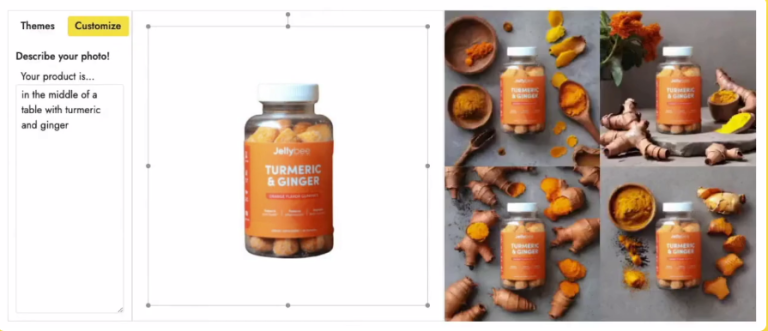
Imagine a design software that proposes layouts, colors, and typography based on target audience preferences, current trends, and design principles.
One of the most popular applications of AI in images is the ability to detect and recognize patterns, objects, and people.
From unlocking smartphones to advanced security systems, facial recognition is just the tip of the iceberg in AI capabilities.
Applications like autonomous vehicles and surveillance systems benefit from AI’s ability to identify objects in real time, understanding their environment and acting accordingly.
The art world is also being transformed by AI.
There are AI systems that have created pieces of art, some of which have been sold at auctions for significant sums.
AI can be used to analyze artworks, determine their authenticity, and even offer information about the artist’s technique and materials used.
If you think what we’ve seen so far is impressive, wait to see what the future holds in the realm of AI and images.
With the combination of AI and Augmented Reality (AR) and Virtual Reality (VR), we are heading towards the creation of hyper-realistic virtual environments. These spaces could be indistinguishable from reality, with the ability to interact with them in real time.
We might reach a point where «talking» with images is as common as text. AI could interpret images, respond with images, and create a flow of visual communication.
Imagine an AI capable of identifying diseases or anomalies in medical images with precision that far exceeds human capability. We’re talking about faster, more accurate diagnoses, and ultimately, saving more lives.
Images dominate the digital era, and AI is here to enhance business opportunities.
In the world of marketing, the ability to personalize visual content based on individual user preferences can revolutionize how brands interact with their audiences.
The creation of visual content for advertising campaigns, social media, or products could be accelerated and optimized with the use of AI, reducing costs and production times.
AI can analyze images to obtain valuable insights, from evaluating the effectiveness of an advertising campaign to detecting emerging trends in consumer behavior.
The role of AI in automating the visual field is not just promising; it’s revolutionary.
Editors and photographers will be able to use tools that automatically propose and apply corrections, filters, and effects based on the image’s context and the creator’s intentions.
AI can automate the tedious task of organizing and tagging large image libraries, identifying content, subjects, and themes, and categorizing them appropriately.
AI will be able to track and detect unauthorized use of images, protecting the work of photographers and creators and ensuring they receive proper credit and compensation.
The intersection of artificial intelligence and images is reconfiguring the canvas of the visual world. For editors, photographers, and businesses, the opportunities are immense and transformative. At All Ai Tools, we look forward to a bright and colorful future in this convergence. 🌌📸🔮
AI Image refers to the application of artificial intelligence (AI) in tasks related to the processing and enhancement of images. This technology uses trained AI models to analyze, edit, and enhance images in various ways, such as enlarging images, completing missing parts, and vectorizing images.
You can use AI Image to enhance an image by uploading it to an AI-powered image editing platform. The AI will apply automatic improvements like color adjustment, sharpness, and noise reduction to achieve a higher-quality image.
AI for enlarging images uses image processing algorithms to increase the size of an image without losing quality. This is useful when you want to obtain a larger version of an image without it becoming blurry.
AI for completing images can identify missing areas in an image and generate visually coherent content to fill those spaces. This is useful for restoring damaged images or correcting imperfections.
You can find online tools that allow you to enlarge images using AI. These platforms enable you to upload an image and apply enlargements without loss of quality. Make sure to search online to find a tool that suits your needs.
You can edit an image with AI by using image editing software that integrates AI capabilities. These programs can offer advanced features for image enhancement, retouching, and adjustments.
Vectorizing an image with AI means converting a bitmap image (pixels) into a vector image. This involves representing the image in terms of geometric shapes, allowing it to be enlarged without loss of quality and to make precise edits.
You can search for AI Image tools to vectorize images online or use graphic design software that offers this function. Make sure to explore options that fit your image editing needs.